
How does the measure of placing children or young people in conflict with the law in an institutional re-education institutions (diagnostic institute/center, children’s home with a school, educational institute, or re-education center) affect their safeguards guaranteed by European legislation (in particular Directive 2016/800)? And why does this practice disproportionately affect children and young people who face structural disadvantages (poverty, social exclusion, racial discrimination, discrimination based on disability)? Does it ultimately only exacerbate social inequality and shift responsibility for structural failures onto its victims? And is there no other way to uphold the idea that children and young people in conflict with the law need to be treated differently, while avoiding interference with their personal freedom and the framing of structural disadvantages as risk factors?
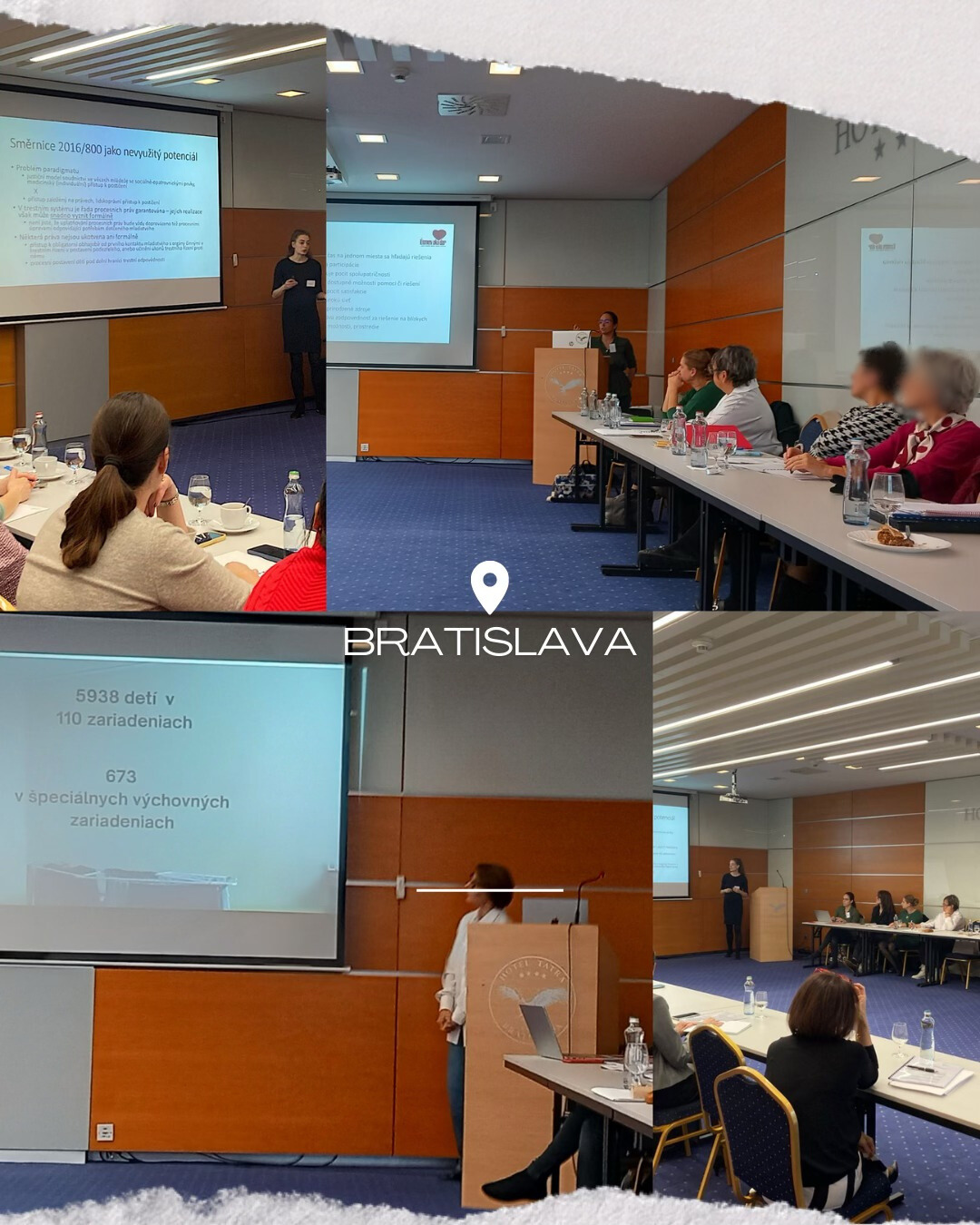
These were the themes we addressed at two expert seminars held on November 4, 2025, and in Bratislava and November 12, 2025, in Prague. We are very pleased that we had the opportunity to meet with practitioners from the fields of legal practice, probation, social work, and restorative justice, as well as representatives of central authorities who influence policies and strategies in this area.
We sought to combine together theoretical (legal-philosophical and social-scientific) and practical insights into the topic, and we are very happy that we had the opportunity to collaborate with representatives of organizations that work directly in the field with children and young people facing structural disadvantages (Tenenet, o.z., Ratolest Brno, z.s.), as well as with experts who advocate for strengthening the restorative justice approach (not only) to addressing the repercussions of unlawful conduct in Slovakia and the Czech Republic (ReStart, o.z., Institut pro restorativní justici).
We consider the presentation of family conferences to be very important as an approach that restores competence to the children concerned and their families, builds on their strengths, and creates space for their voices and life experiences to be heard in the search for solutions to their situation. We would like to thank Úsmev ako dar and RK Centrum (Amalthea, z.s.) for introducing this approach.

Both seminars were held as part of the ACCESS project (Access to Justice for Children Accused and Suspect in Criminal Proceedings), coordinated at the international level by the International Commission of Jurists – European Institutions and funded by the European Commission.
In addition to us at Forum For Human Rights, the national partners of the project are:
- Bulgarian Helsinki Committee Association (BHC) (Bulgaria)
- Helsinki Foundation for Human Rights (HFHR) (Poland)
- Défense des Enfants International (DEI Belgique) (Belgium)
- Nederlands Juristen Comite Voor Demensenrechten (NJCM) (Netherlands)
As part of the project, a simple leaflet in an “easy to read” version, and information brochure were created for children and young people facing suspicion or accusations of illegal activity, in both Slovak and Czech. The materials are available for free download and can be used in your work.

